

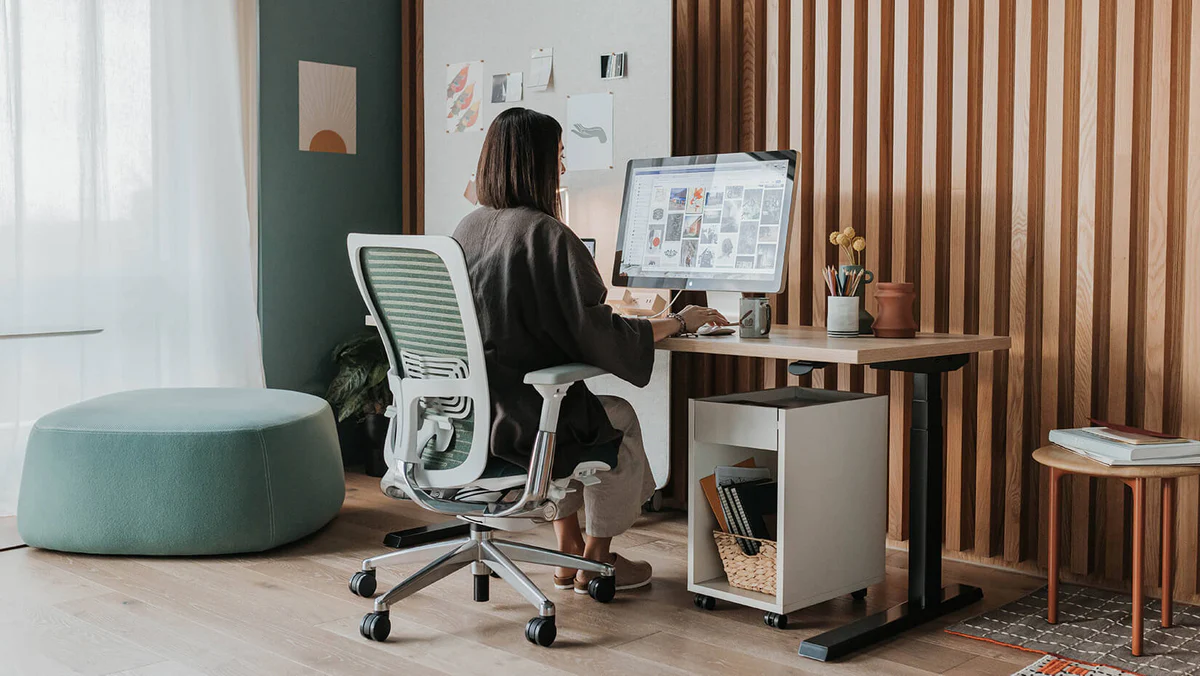

Most people design a home office for the photo, not the workday. The reclaimed-wood desk, the framed prints, the plant catching morning light. Pinterest is full of it. What almost nobody plans for is the eight-hour shift that has to happen at that desk, and whether the room can hold up under it.
That’s the gap where most home offices fall apart. The room looks great and feels wrong. Your shoulders ache by lunch, the glare on the monitor makes you squint, and the shelf above your head sags a little more every month. So how do you build a home office that still works once you sit down and start working?
Start With the Desk, Not the Decor
The desk is the one thing you can’t get wrong. Everything else in the room is negotiable. If the desk height is off, your body knows within an hour.
According to American Business Equipment, the standard office desk sits 28 to 30 inches from the floor, and a proper setup lets your elbows form a 90-degree angle while typing, with forearms parallel to the floor. That’s the whole target. Your chair does most of the adjusting, but the desk sets the ceiling on how right the setup can get.
Tall? A standing-desk converter or an adjustable base handles it. Shorter? A shallower chair and a footrest can bring you into range without replacing the desk.
Fit the desk to the person, not the person to the desk.
Light the Room for Working, Not for Photos
Home office lighting gets treated like mood lighting. Warm bulbs, one lamp, maybe a candle. That works fine for a reading nook. It’s the wrong setup for a screen.
Two numbers are worth knowing when you plan the light in the room:
- Ambient level. Aim for roughly 20 to 30 lumens per square foot of general room light so the space isn’t a cave around a bright screen.
- Task level. A dedicated desk lamp should push 450 to 800 lumens onto the work surface, with 700 to 1000 lumens if you read or write on paper often.
- Color temperature. Cooler bulbs in the 4000K to 5000K range work best for focused screen time, because they read closer to daylight than a warm 2700K bulb.
Layer the light. Overhead for the room, task lamp for the desk, and a small accent light behind the monitor to soften the contrast. Your eyes will feel the difference by 3 p.m.
Storage Has to Carry the Weight You’ll Actually Put on It
Shelves are where a beautiful office turns into a hazard. A shelf that looks solid can still sag, bow, or pull out of the wall over time. The material matters more than the finish.
A standard 3-foot by 1-inch by 12-inch shelf holds roughly 313 pounds in oak, 200 in pine, 129 in plywood, and only 87 in MDF, with a normal quarter-inch of sag that grows another eighth of an inch over the years. Books add up faster than people expect. So do binders, monitors, and printers stacked on floating shelves.
Mount into studs, not drywall anchors, whenever the load is real. In most homes, studs sit 16 inches apart, though older homes may space them 24 inches apart, so measure before you commit to a spot. A shelf is only as strong as what it’s screwed into.
Design for the Hours You’ll Spend There
Remote and hybrid work aren’t going anywhere. Roughly 35% of employed people did some or all of their work remotely last year, up slightly from the year before, according to recent survey data. That’s a lot of hours to spend in one room.
Design accordingly. Put the desk where natural light hits from the side, not behind the screen. Keep a clear sight line to something other than a wall if you can. Leave floor space for a second chair, because eventually someone will join a call or drop off coffee.
If you want a starting point for the visual side, browsing real home office layouts is a good way to see how other people solved the same problems in different footprints. Look past the styling and study the bones: where the desk sits, how the light enters, what’s within arm’s reach.
Small Details Do the Heavy Lifting
Once the desk, light, and storage are right, the rest is finishing work. Cable management under the desk. A rug that softens the room without catching chair wheels. A door you can close when the workday ends.
None of it is glamorous. All of it is the difference between a home office you enjoy and one you avoid.

Comments are closed.