

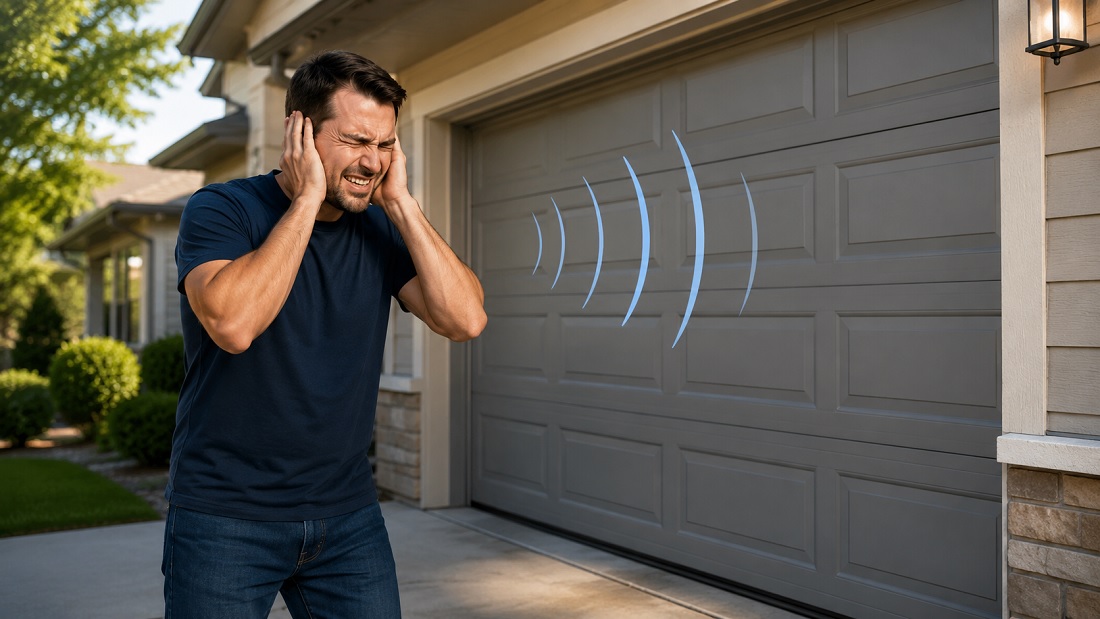
Why Your Garage Is Louder Than the Rest of Your House and What That Noise Is Actually Telling You

That rattling roll-up at 6:47 a.m. isn’t a quirk of the house. You’re paying for it in three currencies at once: sleep, repair bills you haven’t scheduled yet, and, in the worst cases, air you’d rather not be breathing. A garage that sounds louder than the rest of your house usually is louder, and the reasons why point directly at what’s failing, what’s missing, and what’s about to cost you money.
The noise isn’t the problem. The noise is the diagnostic.
Garages Usually Aren’t Built for Silence
Walk through the wall assembly between your kitchen and your bedroom, then compare it to the wall between your kitchen and your garage. The garage side is almost always the thinner story. One layer of drywall, often unpainted. Insulation batts installed for fire code and thermal separation, not for sound.
A slab runs continuously under both spaces, and the ceiling is frequently the underside of a bedroom floor. That construction is fine for storing a car. It’s a poor barrier for a 200-pound steel panel opening on metal rollers, a motor bolted straight to ceiling joists, and torsion springs releasing energy every cycle.
Acoustic engineers rate walls with a number called Sound Transmission Class. A standard STC scale runs roughly 25 at the low end to 60 or higher at the top, and most garage-to-house walls sit near the bottom of it. That’s the whole reason a chain drive in the garage sounds like a chain drive in the hallway.
What the Noise Is Actually Telling You
Different sounds map to different problems. Learn the vocabulary and you’ll know whether you’re looking at a ten-minute fix or a service call.
- Grinding or squealing. Worn rollers, dry hinges, or bearings past their service life. Manageable with routine maintenance, but ignoring it accelerates the wear on everything downstream.
- A steady, rhythmic clatter. Almost always a chain-drive opener doing what chain-drive openers do. A belt-drive opener runs on a rubber belt instead of metal, which is why it’s the default recommendation whenever a garage sits under a bedroom.
- A sudden loud bang. Treat this as urgent. It often means a torsion spring has snapped, and a door with a broken spring is heavy, unbalanced, and dangerous to operate. Don’t lift it by hand.
- A rumble that travels. If you feel the noise in the floor above the garage, the issue isn’t just the door, it’s the structural coupling between the opener, the framing, and the living space.
- An engine you can hear too clearly. This one’s the most dangerous item on the list, and it has nothing to do with the door itself.
The Noise You Should Never Ignore Has Nothing to Do With the Door
If you can hear a car idling in the garage from inside the house, air is moving from that space into your living space. That’s not an acoustic curiosity. Pressure differences between an attached garage and the house pull exhaust inward, and carbon monoxide doesn’t announce itself.
The EPA’s guidance on indoor CO risk is blunt: never run a vehicle or gasoline engine inside a garage, even with the overhead door open. The sound of the engine is a proxy for the airflow you can’t see. If the noise is coming through clearly, so is everything else.
What Actually Works, in the Order That Matters
Fixing garage noise properly is a sequence, not a shopping list. Do it in this order and you’ll spend less money and get a better result.
- Diagnose before you buy anything. Identify the sound. A grinding roller and a failing spring look nothing alike on an invoice. If a noise falls into the urgent category, get a professional garage door inspection before the door drops on something you care about.
- Service the hardware. Replace worn nylon rollers, tighten hinges, and lubricate with a proper garage-door product. Nylon rollers alone can drop the noise floor of an old door dramatically.
- Change the opener if it’s a chain drive above living space. A belt drive, or a wall-mounted jackshaft opener that removes the ceiling mount entirely, is one of the more effective upgrades for houses where the garage sits under a bedroom or home office.
- Seal the perimeter. Fresh weather stripping around the door and a good bottom seal reduce airborne noise and, more importantly, cut the air pathway that carries exhaust and dust into the house.
- Upgrade the wall assembly if you’re serious. This is a bigger project, but a proper soundproofing approach uses added mass, decoupled drywall, and dense insulation, in that order. Surface absorbers come last, not first.
The garage probably won’t match the primary bedroom for calm. But it also shouldn’t wake the house at 6:47 in the morning, and it shouldn’t be the loudest room by accident. Once you know what the noise is telling you, the fix stops being a mystery and starts being a plan.

Comments are closed.