

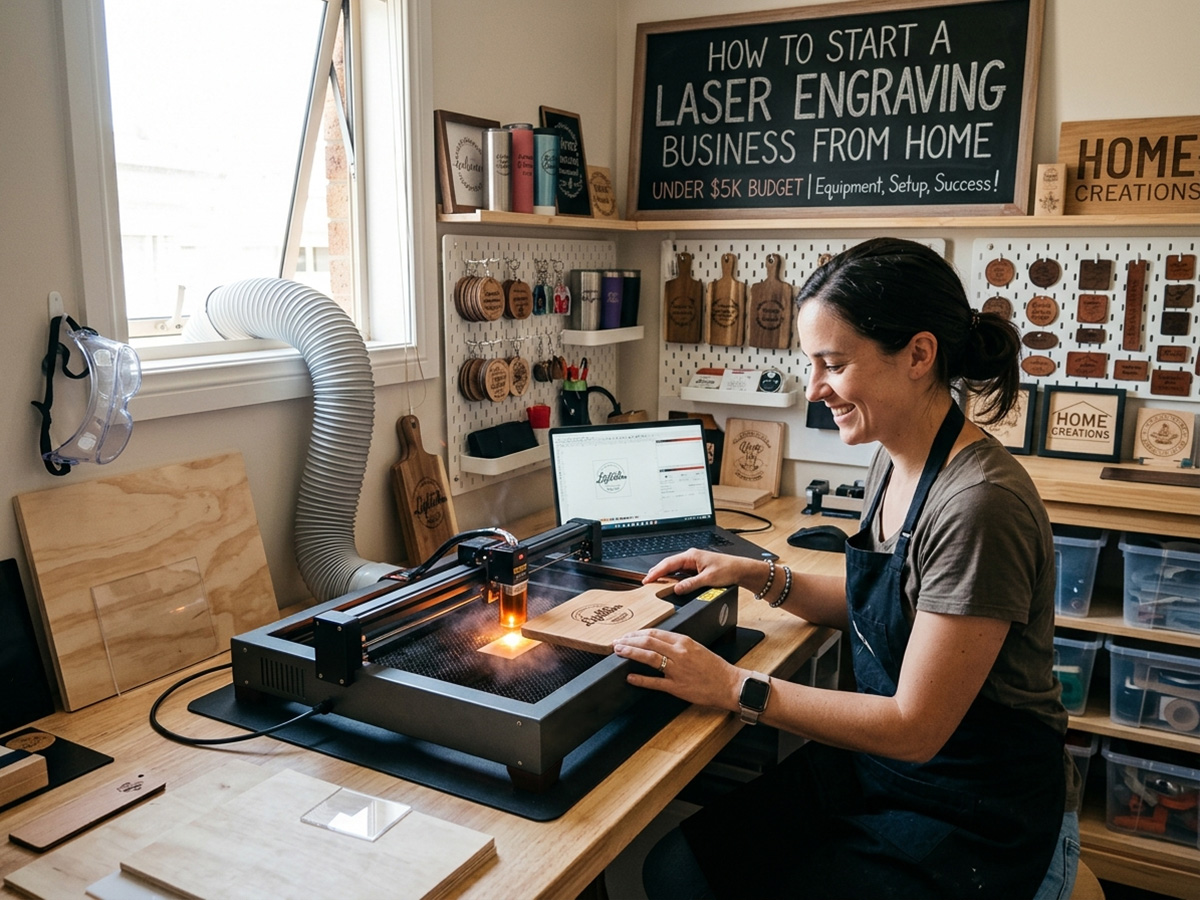

The box said “desktop,” so it went on the desk. The desk sits in the room the family also uses for homework, laundry folding, and the dog’s water bowl. That decision, made in the first ten minutes after unboxing, is where most of the risk in home laser engraving settles in long before the first project burns.
Hobby-grade machines have gotten cheap, capable, and small enough to live anywhere. That’s the problem. A tool powerful enough to cut wood and acrylic gets treated like a sewing machine, and the room it lives in was rarely designed to host one.
Why “I’ll Just Be Careful” Falls Apart in a Shared Room
The usual plan is personal vigilance: wear the goggles, don’t look at the beam, keep the kids out. In a dedicated workshop that plan has a chance.
In a kitchen, basement rec room, or spare bedroom shared with the rest of the household, it erodes fast. A short laser safety course aimed at operators covers the hazard classes, control measures, and eyewear math that a machine’s quick-start guide skips entirely.
The failure modes are predictable:
- Interruptions during a cut. A ten-second question from a family member is a ten-second window where the goggles come off, the lid opens, or attention leaves the machine while it’s still firing.
- The curious bystander. Guests, kids, and pets wander toward a glowing, humming box. Safety authorities are blunt that children should never operate these machines, and even teenagers need continuous adult supervision around high-class units.
- Fume creep. Engraving acrylic can release formaldehyde, hydrogen cyanide, and other volatile compounds that drift into whatever room shares the HVAC. A fan in the window is not ventilation; it’s wishful thinking.
- The wrong material. PVC and vinyl look like harmless plastic and are stocked in half the craft bins in the house. Under a laser they release hydrogen chloride, which corrodes the machine and the lungs of anyone nearby.
None of these are user-error outliers. They are what happens when a Class 3B or 4 device lives in a room designed for other activities.
Treat the Corner of the Room as a Small Laser Area
The fix is not a bigger pair of goggles. It’s borrowing the controls that workplaces use and shrinking them to fit a home. Formal training sources, including OSHA’s guidance, spell out the layers: engineering controls first, administrative controls next, personal protective equipment last. Hobbyists tend to start at the end of that list and stop there.
A workable home version looks like this:
- Give the machine its own footprint. A closed door, a labeled zone, or at minimum a corner no one walks through while it runs. Interlocks stay installed. Lids stay down.
- Vent outside, not into the house. Ducted exhaust through a window or wall port, with a sealed inline fan. Keep a materials list taped to the machine and treat unidentified plastics as suspect until you can confirm what they are.
- Set house rules in writing. Who’s allowed to run it, who’s allowed in the room while it’s firing, and the simple rule that the operator finishes the job before answering the door.
The craft room doesn’t need to become a clean room. It needs to be run with the awareness that a serious piece of equipment moved in, and the household, not the manufacturer, is now the safety officer.

Comments are closed.